Writing/2026-05-19
Reasoning Is The New Bandwidth
A note on AI reasoning cost curves, industrial estimation, and what becomes viable when intelligence stops being scarce.
I have been building a bid estimation tool for a friend of mine who owns an industrial painting and coating company. A typical run ingests a full project package; i.e., specs, RFQs, addenda, drawings, schedules, and extracts the relevant scope, flags missing or risky information, and returns a structured first-pass estimate that a human estimator can review and price.
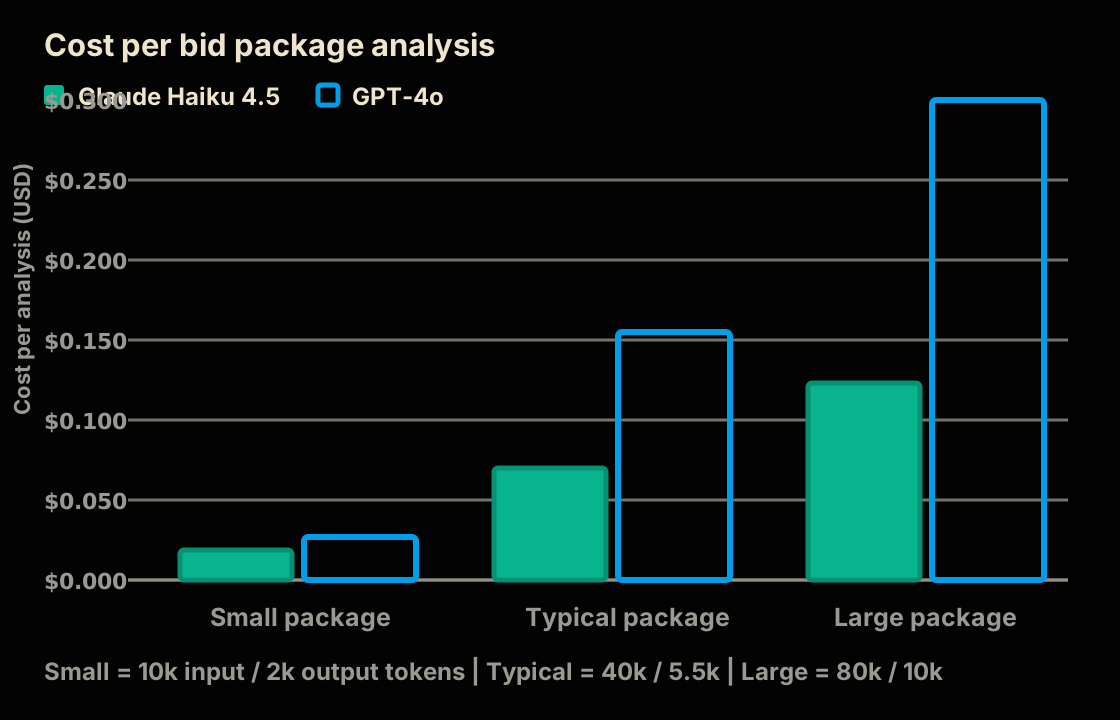
The AI component of that analysis costs $0.07. That number is worth sitting with for a moment.
A year ago, the model you would have reached for to do this kind of work reliably; i.e., long document processing, structured extraction, consistent output across a messy, multi-document package, was GPT-4o. It is capable, widely used, and what most people mean when they say "ChatGPT" in a professional context. The same analysis on GPT-4o costs $0.155. Not ruinous. But 2.3x more expensive, and without the context window that lets you feed an entire bid package in a single call.
The model I am using today is Claude Haiku 4.5. Not a frontier model, but capable enough for this task, and meaningfully cheaper. But the more interesting number is not the comparison between two models today. It is the comparison across time.
GPT-4 launched in March 2023 at $30 per million input tokens. GPT-4o arrived in May 2024 at $5, and halved again to $2.50 by November. Claude Haiku 4.5 handles comparable document-analysis work today at $1 per million input tokens. That is a 97% reduction in the cost of capable AI reasoning in roughly three years.
I have watched a similar curve before, in a different context.
In 1998, internet transit cost approximately $1,000 per megabit per month. By 2010, it was $5. By 2020, it had fallen below $1. The underlying economics of moving data across a network collapsed over 25 years, and what followed was not simply cheaper internet. It was internet embedded in everything - phones, cars, appliances, sensors, watches, agricultural equipment. The falling cost of bandwidth did not just make existing use cases less expensive; it made entirely new categories of products economically viable that would have been absurd when connectivity was scarce. AI reasoning is following the same curve. Faster.
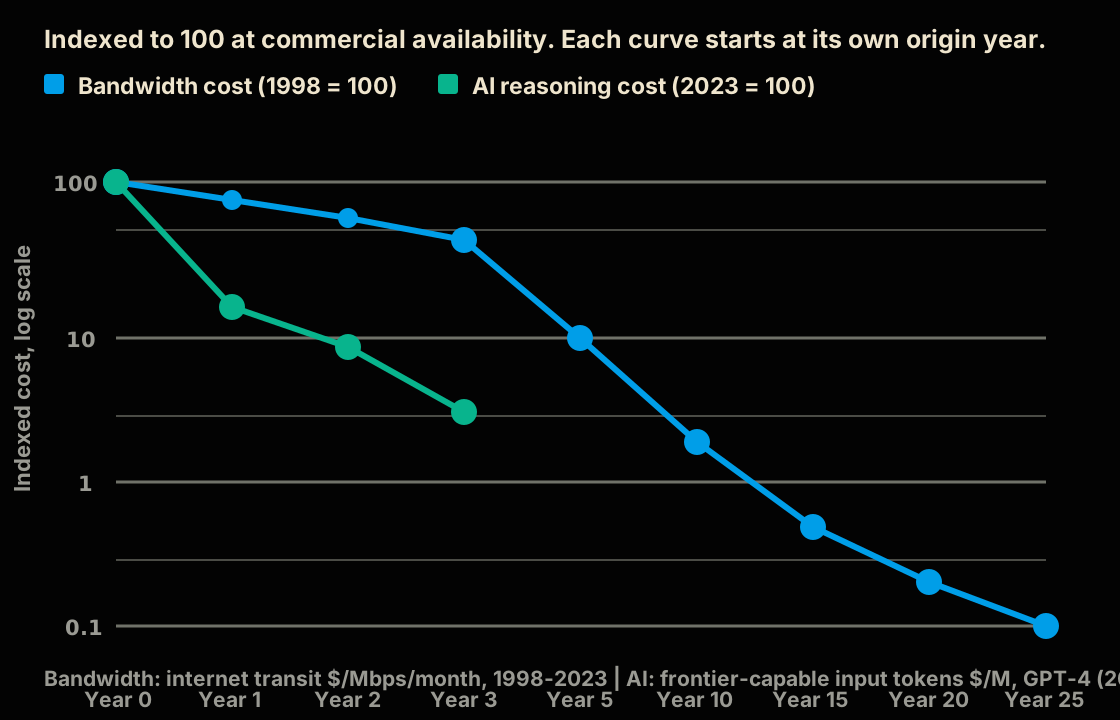
The chart above puts both curves on the same index. Bandwidth took roughly a decade to reach the price level that AI tokens hit in three years. The trajectory is not identical - nothing about infrastructure deflation ever is - but the shape is recognizable.
When bandwidth became cheap enough, nobody asked "should we add internet to this?" They just added it, because the alternative was to explain why you had not. The same question is approaching for reasoning. Not for every application immediately, but faster than most organizations are planning for.
The implications are not primarily about cost savings on existing workflows, though those are real. They are about what becomes viable that was not before. Industrial sensors that interpret their own anomalies. HVAC systems that reason about occupancy and weather before adjusting. Supply chain monitors that read contracts and flag exposure. Estimating tools that process a bid package before the estimator has opened it. These are not science fiction use cases. Several of them are being built right now, quietly, in industries that do not show up in the AI discourse.
None of these products required a strategic decision to "invest in AI." They required someone to notice that reasoning had become cheap enough to include, the same way someone noticed that a data connection had become cheap enough to include in a thermostat.
The estimation tool I am building is not, at its core, an AI story. It is an infrastructure story. The civil engineer estimator using it does not think about token costs; they think about whether the bid is accurate and whether it is ready on time. The AI is infrastructure in the same way the internet connection in the office is infrastructure: invisible when it works, conspicuous only when it does not.
We are early in this. The cost curve has not finished moving. But the question worth asking now is not "can we afford to use AI for this?" It is the same question engineers started asking about bandwidth in the mid-2000s: what becomes possible when we stop treating this as a scarce resource?