Writing/2026-08-15
When Making Becomes Cheap
How a Dutch sawmill helped change the global economy, and what it can teach us about AI and design.
How did the crankshaft help invent modern capitalism, and what does that have to do with AI?
At the end of the sixteenth century, the Dutch had a problem. They wanted to compete with the Spanish and Portuguese for Asian trade, but doing that required ships. Lots of them. Ships required enormous quantities of lumber, and turning logs into usable planks was tedious, manual, and slow.
The Netherlands already had an abundant source of power. Windmills were everywhere, converting wind into circular motion. The problem was that saws did not need circular motion. They needed to move up and down.
Around 1593, a Dutch mill owner and inventor named Cornelis Corneliszoon van Uitgeest found a way to connect the two. He used a crankshaft to convert the circular motion of a windmill into the reciprocating motion of a rig of saws. Suddenly, the wind could cut lumber.
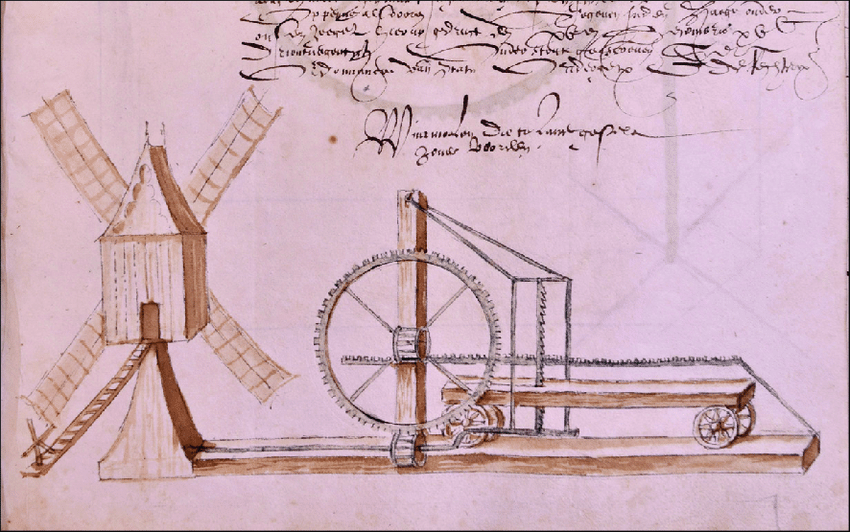
It was a relatively simple mechanism with an enormous effect. Wind-powered sawmills could process around 60 beams in four or five days, compared with roughly 120 days by hand. That is an increase approaching 30x. Lumber became cheaper and faster to produce, helping Dutch shipyards build unprecedented numbers of ocean-going vessels.
Cheaper lumber meant more ships. More ships meant more trade. More trade helped create the conditions for the Dutch East India Company, or VOC, which pooled long-term capital from investors and issued transferable shares. Those shares gave rise to a secondary market in Amsterdam and helped establish some of the foundations of modern capitalism.
The crankshaft did not invent capitalism by itself. History is obviously more complicated than that. But it removed a critical constraint at precisely the moment when the surrounding system was ready to take advantage of it. What had been slow and expensive suddenly became cheap and fast, and the consequences moved far beyond the sawmill.
AI is the wind, not the crankshaft
The obvious comparison is that AI is our modern crankshaft. I think the more useful comparison is that AI is the wind.
Foundation models provide an increasingly abundant source of productive power. They can generate words, images, interfaces, prototypes, code, analysis, and structured data at a speed and cost that would have seemed implausible only a few years ago.
But raw power is not the same as useful work. The Dutch had wind before they had automated sawmills. The important innovation was the mechanism that connected that power to a specific constraint.
We are still building those mechanisms for AI.
A chat window attached to a language model is useful, but it is not necessarily a crankshaft. Neither is adding a generic assistant to an existing application. The crankshaft is the workflow, product, interface, or organizational system that directs AI toward a real bottleneck and makes the output reliable enough to use.
In design, that might mean connecting AI to research repositories so it can surface relevant evidence during product decisions. It might mean connecting generation directly to a design system so that an idea becomes production-quality UI rather than a plausible-looking mockup. It might mean turning a working prototype into a continuous environment for testing, learning, and iteration. The model supplies the power, but the surrounding mechanism determines whether that power changes anything.
When UI becomes cheap
I have already watched part of this transition happen.
When I started building Semanttic, generating a UI from a text prompt was still a novelty. The more important step was connecting that capability to real enterprise design systems. A generic interface was not especially valuable. An interface using the right components, tokens, patterns, and rules could become part of an actual production workflow.
That connection compressed work that had previously taken days into minutes. UI production, once one of the slow and expensive parts of digital product development, started becoming cheap and fast.
This is clearly useful, but it creates another question: what happens after UI is no longer the constraint?
This connects to something I wrote about in The Weak Links in Design. Design is not one activity. It is a chain of research, synthesis, framing, product direction, alignment, prototyping, delivery, adoption, and measurement. Strengthening one link does not automatically strengthen the whole chain.
If AI makes interface production 30x faster, we do not necessarily get products that are 30x better. We may simply expose the next weak link.
When UI generation becomes cheap, deciding what should be built becomes more important. When prototyping becomes instant, the ability to evaluate alternatives becomes scarce. When teams can generate unlimited concepts, taste and judgment matter more. When producing artifacts is no longer the bottleneck, organizational alignment, technical integration, governance, trust, and adoption become more visible constraints.
A weak design process with AI may simply become a faster weak design process.
The second- and third-order effects
The first-order effect of the wind-powered sawmill was straightforward: lumber became faster and cheaper to produce. The more important effects appeared later, elsewhere in the system.
AI will probably follow a similar pattern. The first-order effects are already visible: faster drafts, faster synthesis, faster UI, faster prototypes, and faster code. These are the productivity gains most organizations are measuring because they are immediate and relatively easy to see.
The second-order effects are about how the work reorganizes itself. If interface production requires far less time, design teams may spend more time on problem framing, product strategy, evaluation, facilitation, and working directly with engineers and domain experts. Some roles will compress. Others will expand. Value will move toward the parts of the process that remain scarce.
The third-order effects may be larger. When software becomes dramatically cheaper to create, many products that were previously too small, too specific, or too strange to justify may become viable. Companies may build software for a single workflow, team, customer, or recurring decision. Interfaces may become temporary and generated around the task rather than designed as fixed destinations. The boundary between a document, a workflow, an agent, and an application may become increasingly difficult to see.
The sawmill did not simply produce more lumber. It changed what could be built at scale. AI will not simply help us produce more software. It will change what kinds of software are worth building, and who can build them.
Technology amplifies intent
There is another part of the Dutch story that should not be ignored. The VOC was not simply a financial innovation or a remarkable feat of coordination. Its success was also built through monopoly, colonial extraction, coercion, and violence.
That matters to the analogy. Technology does not determine what the systems around it will optimize for. It expands their capacity to act. The same shipbuilding capability that enabled trade also enabled conquest. The same financial structures that distributed investment also financed colonial expansion.
AI will amplify the priorities of the organizations that deploy it. If the surrounding system values speed above understanding, AI will produce more output faster. If it rewards surveillance, manipulation, or the removal of human agency, AI can scale those things too. If it is designed around better judgment, wider access, clearer decisions, and more useful products, it can amplify those instead.
The mechanism matters, but so does what we connect it to.
We now have access to an extraordinary new source of productive power. The question is not whether AI can make design faster; it already can. The more consequential questions are where we attach it, which constraint it removes, and what becomes possible after that constraint is gone.
The wind is already blowing.
We are still deciding what to connect it to.
References
- Aoife Daly, Marta Domínguez-Delmás, and Wendy van Duivenvoorde, “Batavia shipwreck timbers reveal a key to Dutch success in 17th-century world trade,” PLOS ONE, 2021.
- Oscar Gelderblom and Joost Jonker, “Completing a Financial Revolution: The Finance of the Dutch East India Trade and the Rise of the Amsterdam Capital Market, 1595–1612,” The Journal of Economic History, 2004.
- Cornelis Corneliszoon van Uitgeest and the wind-powered sawmill, Rijksmuseum.