Portfolio/Semanttic
2022–2025
Leadership
Turning written requirements into editable application flows
An AI product design startup that turned ideas into editable application flows and user interfaces for back-office applications.
I founded and led the company across product development, product design, product strategy, research, interaction design, design systems, fundraising, sales, hiring, and operations.
- AI Product Design
- Enterprise UX
- Company
- Semanttic
- Role
- CEO / Founder
- Period
- 2022–2025
- Type
- Leadership
- Delivery
- Beta product + paying users
Contribution
Founder-led direct contribution across product development, product design, strategy, research, sales, fundraising, hiring, and operations.
At a glance
- 15,000+ interfaces
- 200+ research sessions
- Paying beta users
Semanttic explored a focused product question: could generative AI shorten the distance between a written product requirement and an interface that a team could actually inspect, edit, test, and build?
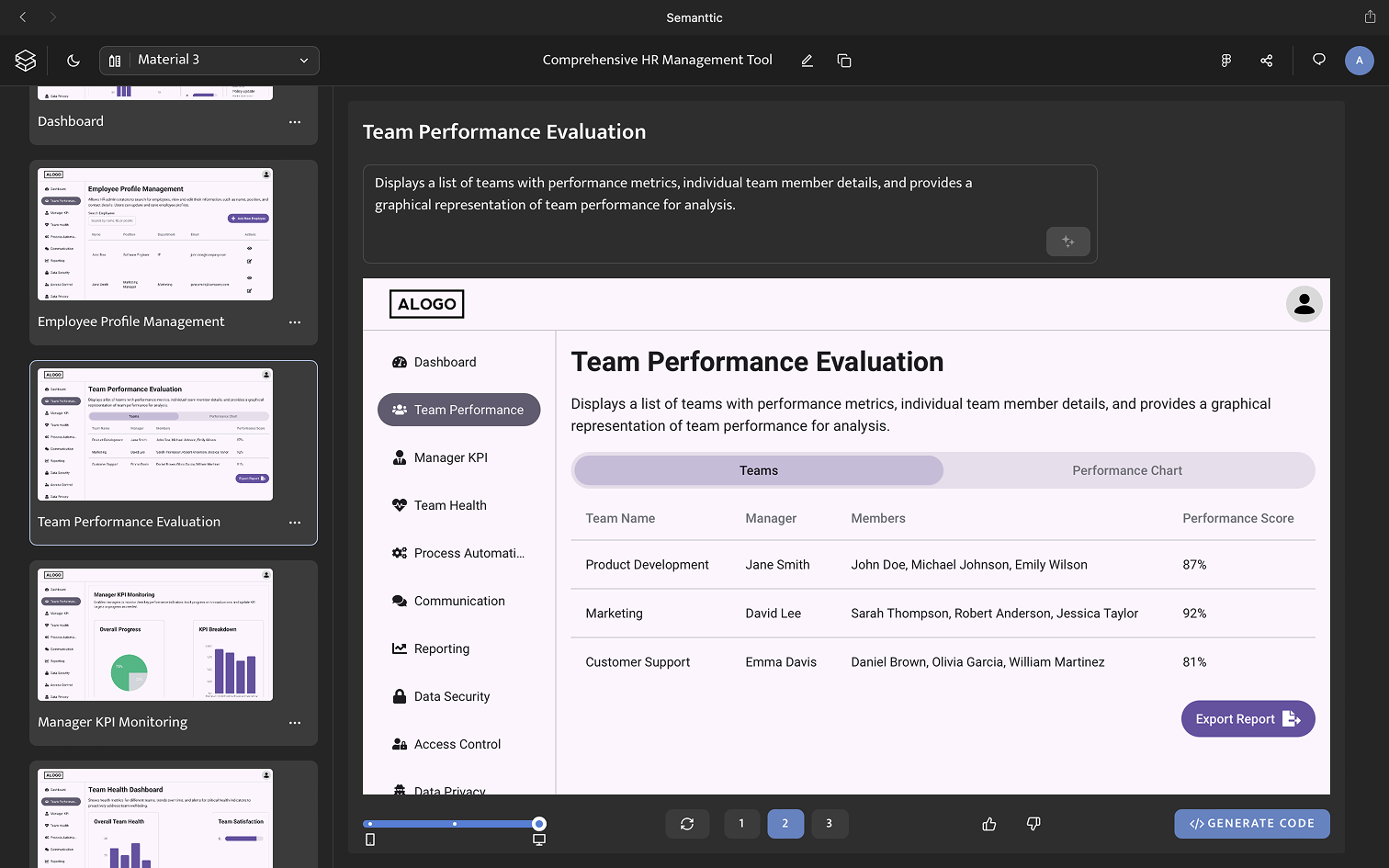
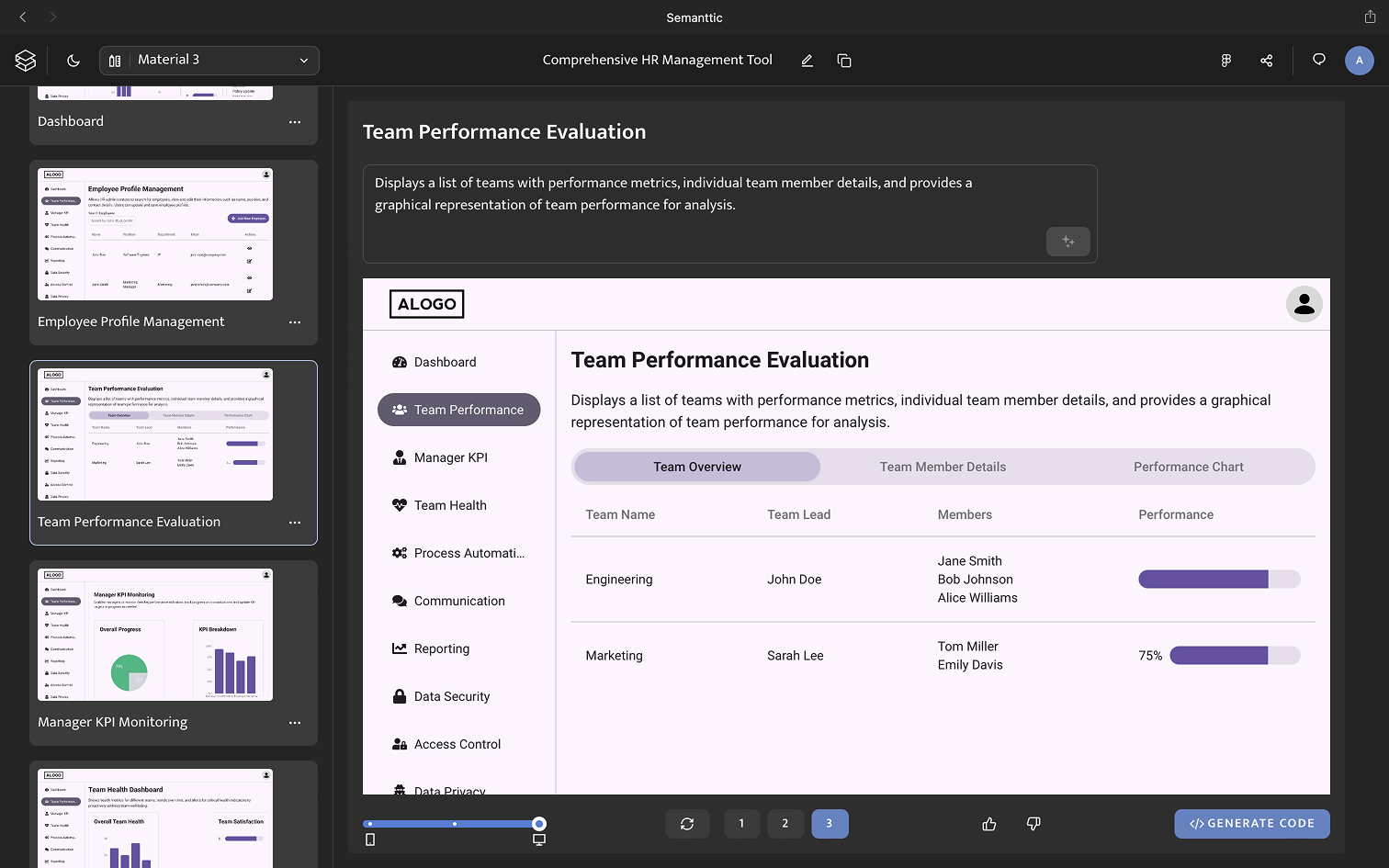
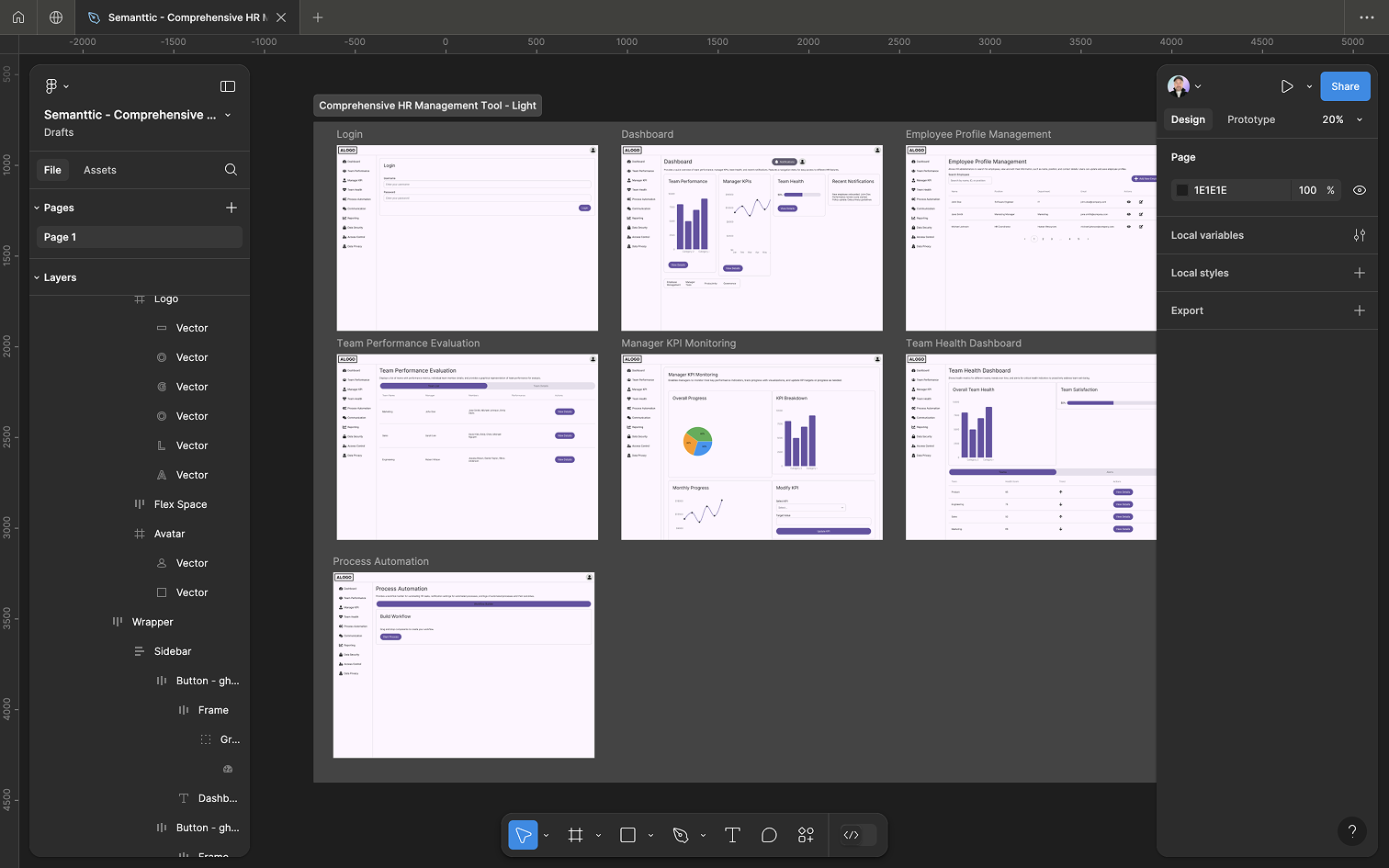
The initial market was enterprise and back-office software, where complex workflows, mandated tools, and fragmented design systems often make interface quality expensive to improve. The product turned requirements into a connected application flow rather than a single decorative screen.
Before the product was possible
In spring and summer 2022, I used the OpenAI Playground alongside DALL·E, Midjourney, and Stable Diffusion to explore whether emerging generative models could help build interfaces. The experiments could sometimes produce front-end code or something that resembled a UI, but the composition was weak. Buttons appeared in arbitrary places, fields were poorly organized, and the results looked like interfaces made without an understanding of layout or interaction design.
The ChatGPT research preview in November 2022 changed what felt possible. After getting a simple website working, I built the first Semanttic alpha around a canvas. A prompt was decomposed into navigation, states, and multiple responsive mobile-web screens. The output was front-end only, with no editing or design-system support, but it established the core idea: generate a connected interface rather than a single image.
I began working on Semanttic full time in January 2023. The product then developed through the LAUNCH Accelerator, more than 200 founder-led interview and product-feedback sessions, the Techstars Miami spring 2024 cohort, and a Volvo CampX evaluation with more than 100 registered internal users. These programs matter here as product-research environments: each one exposed the workflow to more realistic requirements, users, and constraints.
From experiments to working product
2022
Early experiments
Test whether language, image, and code models could compose usable interfaces rather than disconnected fragments.
Late 2022
Alpha Release
Turn a product idea into navigation, states, and multiple responsive mobile-web screens on one canvas.
Jan 2023
Going Full-Time
Commit to developing the alpha into a product and begin the LAUNCH Accelerator.
2023
April teaser
A concept video made the product hypothesis tangible enough to start structured customer conversations.
Spring
Proof of concept
A technical prototype demonstrated that written requirements could become structured application flows.
Summer
Beta and paying users
A small team moved the concept into a usable beta, enterprise pilots, and early commercial evidence.
Nov 2023
Seed Funding
Secured an initial seed investment through This Week in Startups, followed by additional backing from Bay Area investors and Techstars to continue product development.
Nov 2023
Public launch
Semanttic launched in November 2023 with a complete requirements-to-editable-UI workflow.
2023–2024
200+ research sessions
Interviews, demos, product use, and feedback conversations continuously shaped the workflow.
2024
Volvo Pilot
A Volvo CampX pilot brought more than 100 registered internal users into an evaluation of the product with real enterprise requirements.
Apr 2025
Exit
Semanttic’s technology was acquired by a European consultancy for use as a proprietary internal tool supporting forward-deployed engineering services. I then joined Volvo to continue scaling AI-powered enterprise application development internally.
The product sequence
The workflow was designed as a chain of useful product decisions. Each stage made the next one inspectable instead of hiding the process behind a single prompt.
Research also showed that the difficulty began before interface generation. Many people struggled to write a useful initial prompt, so I built ChatPRD.com as a companion tool for creating a structured product requirements document that could be brought into Semanttic. As model capabilities changed, we also built a router that assigned different tasks to the models that performed them best instead of tying the complete workflow to one model.
Input
Requirements prompt
Describe the product, users, tasks, workflow, constraints, and business context.
Structure
Generated user stories
Translate the brief into structured tasks and application requirements that can be reviewed.
Flow
Application flow
Organize the proposed screens and navigation into a connected end-to-end journey.
Interface
Responsive, editable UI
Preview and refine individual screens across viewport sizes instead of accepting a fixed image.
System
Design-system selection
Apply a company design system or an available system so the output fits a real product language.
Output
Code export
Move a selected direction toward implementation through generated front-end code.
Evidence, with attribution
15,000+
Generated user interfaces
Internal product telemetry
200+
Founder-led interview and product-feedback sessions
Internal research record
100+
Registered users in the Volvo CampX evaluation
Internal program record
Paying users + pilots
Early commercial validation
Internal commercial evidence
What the product demonstrated
- A text-to-prototype workflow could support complex enterprise software rather than only landing pages.
- Product requirements, user stories, flow structure, visual composition, design systems, and code generation could be connected in one working environment.
- Early customer conversations and pilots exposed where generated output needed more control, transparency, and editability.
- Prompt support and task-level model routing were part of the product experience, not infrastructure concerns hidden from the design process.
- The strongest value came from compressing early product exploration while keeping teams able to inspect and change the result.
The exit
In April 2025, Semanttic's technology was acquired by a European consultancy, which uses it as a proprietary internal tool supporting its forward-deployed engineering services. I then joined Volvo to continue scaling AI-powered enterprise application development internally. I now also invest as an angel in early-stage AI startups.
My contribution spanned product development, product design, product strategy, research, interaction design, company building, sales, fundraising, hiring, and operations. The case remains centered on the product workflow, the evidence it generated, and what the team learned from putting it in front of customers.
Next case study
SHAPE Design SystemThe first global Electrolux design system, spanning mobile apps, physical interfaces, voice, sound, light, and CMF.