Portfolio/DMI / Bombardier
2016–2017
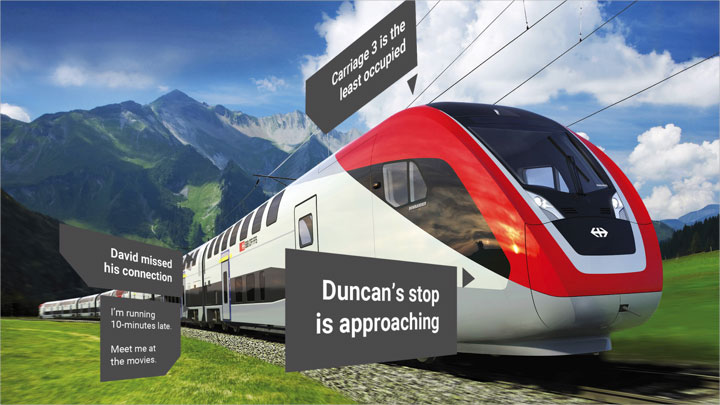
System / Connected Smart Train
Reframing a connected-train request around passenger and operator needs
A discovery, strategy, and pilot program for rethinking train travel through mobility, data, APIs, customer research, and service design.
I shaped the engagement around discovery before implementation and led a multidisciplinary team across UX, service design, business design, and data strategy.
- Service Design
- Connected Products & Services
- Mobility & Automotive
- Client
- DMI / Bombardier
- Role
- VP Customer Experience
- Period
- 2016–2017
- Type
- System
- Delivery
- Strategy + pilot program
Contribution
Led the discovery-first engagement from sales through multidisciplinary delivery and client management, with direct strategy contribution.
At a glance
- Research to pilot
- Passenger + operator
- Data/API strategy
Bombardier wanted to explore how connected services could improve train travel. The first challenge was not choosing a technology; it was understanding which passenger and operator problems were worth solving, and what product and data capabilities those services would require.
62
interviews
Documented project activity
20+
train journeys
Documented project activity
23
concepts
Documented project activity
24
prototypes
Documented project activity
The passenger and operator problem
Travel information and service support are fragmented across the journey. Passengers move between planning, stations, trains, connections, disruption, and arrival, while operators need the information and tools to support that experience. Bombardier also needed to understand how applications, vehicle and service data, and APIs could become a coherent platform rather than disconnected experiments.
I challenged the initial technology-first framing and proposed a discovery program grounded in passenger, employee, operator, and partner needs.
Discovery in the field
The multidisciplinary team used interviews, train journeys, competitive evaluation, journey mapping, concept development, and prototyping to turn a broad connected-train ambition into specific opportunities.
Documented project activity included 62 interviews, more than 20 train journeys, roughly 850 km of fieldwork, approximately 900 research data points, more than 40 evaluated applications, 23 concepts, and 24 prototypes. These figures describe the scale of the work, not market adoption or commercial impact.
What the program delivered
The work produced a connected product direction across three related parts:
- Passenger applications and services across the travel journey.
- Operator capabilities for supporting passengers and service delivery.
- Bombardier data and API capabilities that could enable both.
The program delivered customer-experience strategy, business strategy, a data and API strategy, prioritized service concepts, and tested prototypes. According to the direct project account, it moved into a development phase in 2017.
My role
I was involved from sales through delivery and client management. I reframed the engagement around discovery, led the multidisciplinary program, and contributed directly to the customer-experience, business, data, and API strategy.
The design organization mattered because it allowed research, service design, business design, engineering, delivery, and client decisions to operate as one program. That contribution is reflected in the shape and quality of the delivered work rather than treated as a separate organizational case.
Result and evidence boundary
The verified result is a substantial discovery, strategy, and prototype program that defined a three-sided connected-service platform and progressed into development. Broad market rollout is not independently verified, so the work remains described as a pilot rather than a launched market product.
Results
- Reframed a technology request around passenger and operator evidence.
- Defined a connected product direction spanning passenger services, operator capabilities, and Bombardier data and APIs.
- Produced customer-experience, business, and data/API strategies.
- Developed and evaluated 23 concepts through 24 prototypes.
- Progressed the program into a development phase while retaining an accurate pilot designation.
Next case study
Lynk & Co IVIS ReviewA rapid expert review that exposed systemic usability and delivery risks in a pre-production vehicle interface, helping senior leadership reset the product, team, and supplier approach.More work
SHAPE Design System
Electrolux · Director UX · 2019-2021
The first global Electrolux design system, spanning mobile apps, physical interfaces, voice, sound, light, and CMF.
Design Systems · Connected Products & Services · Design Leadership & Organization
global UX

Product Experience
Electrolux Group · VP Digital & Service Experience · 2017–2023
Physical and digital user experiences across a global appliance portfolio spanning Electrolux, AEG, and Frigidaire.
Connected Products & Services · Design Leadership & Organization
embedded UI · mobile applications · appliance UX
Ownership Experience
Electrolux · VP Digital & Service Design · 2020–2022
A global program to shift appliance ownership from one-time purchase thinking toward lifecycle services, support, onboarding, repair, and repurchase.
Service Design · Connected Products & Services
customer journey · transformation · connected services